
The Namesake
On Vikram Seth and his travels through Xinjiang and Tibet

Few things drag like travel writing. I don’t doubt travel’s restorative quality; my skepticism is around the traveller’s ability to unearth useful truths about places and people. Most of us travel to satiate self-curiosity. Under a thin wrapper of hackneyed description is barely concealed prescription—look, here’s how I view the world. It may explain why the average travel story is a crashing bore.
The genre only comes to life when a skilled narrator is genuinely interested in matters beyond themselves and their companions. Their obsession with noticing remains hidden. There is an urge to get to the bottom of things but the recounting shows no sign of strain.
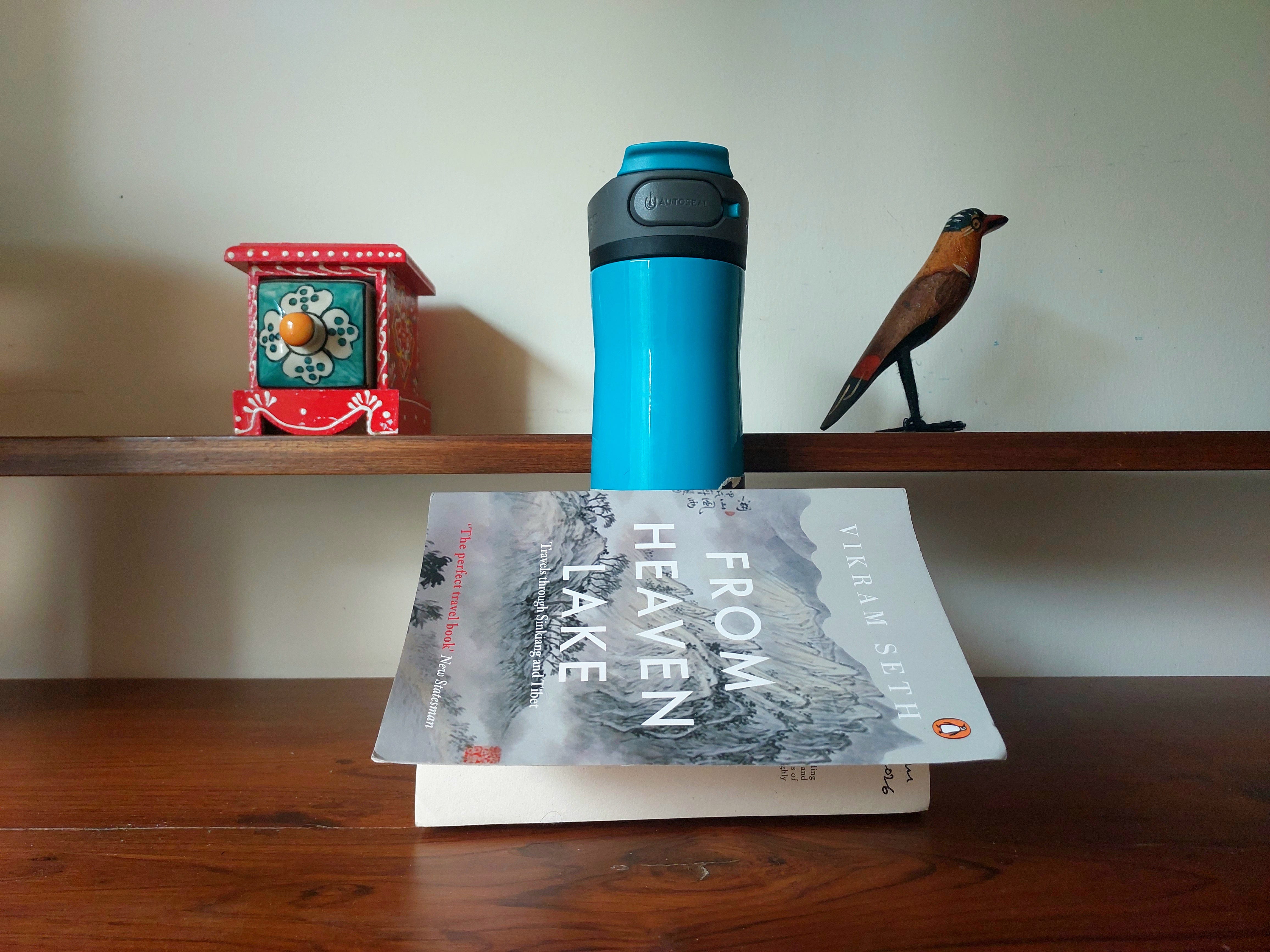
You read Vikram Seth’s From Heaven Lake—a whole forty-two years after its publication—and you realise what the genre is supposed to do. I would have said that it remains, after all these years, “fresh as a bracing spring morning”. But you also read Vikram Seth to be warned against lazy metaphors.
In the early 1980s, Seth, who was in his late-20s and studying economics and demography in Nanjing, hitchhiked on a truck across remote, stunning landscapes in western China to reach Lhasa. The narrative pivots around the bureaucratic question of whether he will be permitted to exit Tibet and enter Nepal through the land border, or be forced to return east to Beijing, and fly back to India via Hong Kong.
Given everything you know now, you’d think this is a low-stakes narrative conflict. Just how much hardship could possibly befall Vikram Seth, son of a Delhi High Court judge and a hotshot corporate executive? Privileged man who would, in a few years, write a landmark novel, and then, in the coming decades, divide his time between the English countryside (as owner of a 17th-century Anglican poet’s rectory, no less), a loving family home in Noida and a pied-a-terre in charming Nizamuddin East?
But here’s the thing—a well-told story causes you to forget everything other than itself; it exists in its own dimension. Precedents, antecedents and portents melt away as you skip along. Reading Heaven Lake, my heart drops when chances of the land crossing look bleak, even as the news is conveyed to Seth by Nepal’s ambassador over a glass of scotch. When Seth belts out ‘Awara Hoon’ (what else!) in the courtyard of a guesthouse in Turfan, I vicariously experience the exhilaration as the Uighur musicians strike up the accompaniment. In Kathmandu, where he arrives haggard after long, cold days on the road, I am moved, as he is, by the flute player in the square.
Then, there is the language, the sheer musicality of it. Seth is many things but he is a poet before all else, my favourite one in the world. When I think of him at work, I don’t imagine furrowed brow and leaden heart; I see him whistling while he works, turning a word here, tweaking a phrase there until he earns his evening scotch & soda for landing the tetrameter to his temporary satisfaction.
Here, I take the liberty to show as poetry some sentences he renders in prose in Heaven Lake:
A light breeze begins to blow
It grows dark, then quickly cold
For dinner, we have lentils and noodles
I sleep on a large wooden double bed in the house
Sui’s muffled snores vibrate through the still night from across the courtyard.
Soon after Heaven Lake, inspired by Pushkin’s Eugene Onekin, Seth would write an entire novel composed of sonnets—The Golden Gate. I didn’t quite appreciate the scale of this achievement when I pretentiously annotated a bright yellow paperback in a university classroom. Of all the books I sold in the final year of college for beer money, this is the only one I regret parting with.
Here is an artist grounded in the fundamentals of his disciplines, but fleet-footed in their practice. In the many interviews he gave following the publication of his English translation of the Hanuman Chalisa in 2024, Seth spoke about the challenges of retaining the ‘rising’ rhyme of the original (say it with me: Jai Hanuman gyan gun sagar, jai kapis teehu lok ujagar) in the iambic nature of English (his example: To be or not to be, that is the question).
What struck me about these interviews (that’s another thing about great storytellers—we will happily sit through repeats) was his rhythmic intonation. The Chalisa has an incantatory effect—why it finds favour with children—but I experienced a similar pleasant, zoning out while reading Heaven Lake. On page, Seth keeps his thematic throughline taut, but always in aid of letting the reader’s imagination unspool in a montage of stark images. See this virtuoso bit on the colours of the Qaidam Basin:
“...The ridges are of pink and slate and purple rock, with cloud-shadows falling on some of them—and the earth to the right is beige and ochre and fawn….later, lakes of distant blue, with a band of sparse vegetation in front, and a red strip of soil nearest us, like the tricolour of an artists’ republic. A sole gold mountain glows in the late light; camels graze on a green plain; the combed raked clouds are yellowed with sunset; and finally, there is darkness, and a salt lake, and the distant lights of Germu.”
I think you can get more out of this passage while gently rocking back and forth as you read. Seth’s ear for rhythm and wordplay is on display in everything he does, including painting vodka bottles for Absolut. He inscribed one of his bottles with a line well-known in Urdu poetry circles: “Na main, na mai”, neither I remained nor the wine. If thoughts are butterflies, what a neat way to net the sensation of a liquor-induced stupor.
He is also a master of dialogue, which is conspicuous by its absence in lesser accounts of journeys. How can you get close to a place without talking to its people? Seth, as usual, does more with less, managing to convey something essential about national character in clipped exchanges in Mandarin, a language he learnt well enough to be able to translate eighth-century poets. Sample this conversation with a truck driver at the depot in Liuyan:
Old Wang appraises me as I light my cigarette. ‘You said you wanted to go to Lhasa?’
‘Yes’
‘There’s a place in my truck. Only problem is, it’s a Liberation truck, not diesel.’
‘What’s the difference?’
‘There’s no heating in a Liberation truck, and it’s really cold on the way.’
‘I don’t mind.’
‘It would be bad if you fell ill. I should get permission from my unit-leaders,” continues Wang in a friendly kind of way. “Your cigarette’s gone out.”
And so it goes over 220-odd pages, human portraits rendered with grace, while accommodating the traveller’s internal churn. Seth’s dynamic with Sui, the truck driver who eventually ferries him, plays out like a beautiful short film. Seth sees Sui for who he is—a man whose “hard-bitten side inspires as much confidence as his patent goodheartedness”—and Sui looks out for Seth but with a kind of reserve for the foreigner that is natural to a working-class Han man (remember that everyone in China was working class in those days).
And here’s another thing about a good story: it requires a callback, a closing of the loop. I had a lump in my throat reading a scene towards the end, when Sui and Seth bump into each other in Lhasa.
Seth etches these specific pictures of human connection while making piercing observations on the fate and nature of nations. On the frosty relations between India and China, he was realistic and prescient: “Neither strong economic interest nor the natural affinities of a common culture tie India and China together. The fact they are both part of the same landmass means next to nothing. There is no such thing as an Asian ethos or mode of thinking.”
I’ve always looked outward, been interested in the world. Yet, I’ve always glazed over when it comes to China. Perhaps it’s for the reason Antony Bourdain (who forever spoiled me for travel stories; I wish he hadn’t left) suggested in an episode set in Shanghai: “The one thing I know for sure about China is that I will never know China. It’s too big, too old, too diverse, too deep. There’s simply not enough time…”
Reading and listening to Seth reinforces that I shy from doing the hard thing, from putting in the toil required to taste and touch a kind of understanding. Typically self-effacing, Seth writes towards the end of Heaven Lake that he couldn’t live a “continuously wandering life” because his “drive to arrive is too strong”, that his “impatience displaces enjoyment.” But this assessment rings much less true of that Vikram—translator of Tang dynasty poets, disobeyer of deadlines—than the one writing this Substack post.
I absolutely adore Vikram Seth. From Heaven Lake is one of my favourite travelogues.
And this essay makes me wish - insist, demand - that the Vikram writing it, would write here more often.
What a charming review! And how delightful to have found it just weeks after I read the book! You've described it so well, now I can share it and tell people: see this is why you need to read it.